
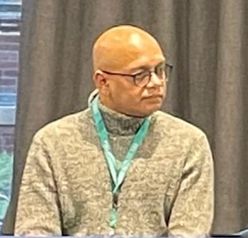
In the months of October to December in 2025, I participated in the SingWell Project. This project is a weekly singing group for people who stutter. I was happy to know my previous singing experience in the shower was acceptable. While this project is undertaken at different parts of the country, my closest location was at the Toronto Municipal University in Toronto. The building had a beautiful, blended architecture reminding me of the past and the future. SingWell is a research project to assess the impact of Group Singing on fluency and wellbeing.
Every Thursday night we sang as a Choir churning out melodies and lyrics with the accompaniment of the piano and sometimes guitar. We sang songs from the 1940s to the 1980s. There were some songs that I knew and others that were new to me. While I liked all the songs, my favourite songs were Johnny Cash’s ”I Walk the line”, Billy Joel’s “Uptown Girl”, Audrey Hepburn’s “Moon River”, and Bill Wither’s “Lean on me”. Our creative voice warmups, which were new at first, turned out to be fun. I met a lot of new people from our community in Singwell.
Growing up with music
At SingWell, we often spoke about different genres of music. It seems that I still enjoy listening to music that I enjoyed when I was at the age to select my own music. I shared that I was exposed to a lot of 80s pop music which played on the radio, which was or may be different from the mainstream music of the Caribbean where I grew up. My elder siblings used to play a lot of 70s disco music at their parties. My parents used to listen to traditional east Indian music, sometimes on vinyl records. We also talked about the future and the pros and cons of music generated by Artificial Intelligence.
I don't stutter when I sing
As a person who stutters, I always wondered why I can seamlessly belt out a tune at any time, but experience interruptions in my speech. I also wondered maybe if I speak like I am singing, I may be fluent. Maybe in the future someone can invent a device that converts singing to normal speaking. According to the Stuttering Foundation, understanding this phenomenon during singing may eventually help us understand stuttering better. They further say that the there is evidence that the brain functions differently for singing rather than speaking. In addition, the rhythmic pattern of music tends to help regulate a person’s breathing and we use our vocal cords, lips and tongue differently when we sing than when we speak.
Benefits of choral singing
According to SingWell, group singing can improve fluency through breathing and vocal repetition. This not only helps people who stutter but individuals with other communication challenges as well. Singing improves confidence and social communication.
For people who stutter, speaking can feel like climbing up a hill sometimes and it can be tiring. With singing, its somewhat different. For me, it felt like floating around in a zero-gravity environment. Sometimes this is the pick me up that we need. I am happy that I joined the SingWell Project, as I know it helped me a lot. When I have bad stuttering days and I have a lot of blocks in my speech or have a bad day in general, I sing. I feel more relaxed and it improves my fluency. I have also joined another choir, and we meet up on a weekly basis to sing.
Sam or Samuel Sinanan was born in Trinidad and moved to Canada in 2018. He is a Chemical Engineer by profession. He is a co-leader of the Toronto Regional Support Group, supports the Conference Planning Committee as a volunteer and is the Project Manager for the CSA's Strategic Initiative to strengthen CSA connectivity with speech language pathologists, teachers and school boards, thus building a springboard to enhance CSA services and programs for children.
The SingWell Project, based at Toronto Metropolitan University, studies how group singing impacts a number of areas involved in our sense of wellbeing. Building on what has grown to be a robust body of research, SingWell researchers are finding that while anyone can reap these benefits, singing with others can be an especially enriching activity when it comes to communication, including for folks who stutter.
What’s more, these benefits arise from participation, not performance. It’s not about how your voice sounds, but the social, emotional, physiological and biological processes at play when we come together to sing.
CSA partners with the SingWell Project.