
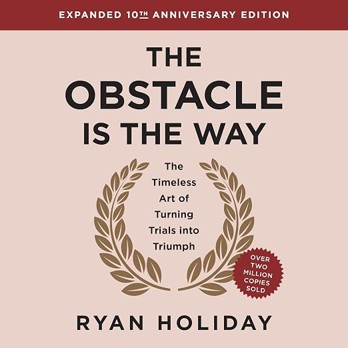
This book the Obstacle is the Way is compact in size at less than 200 pages, and it contains a treasure trove of inspirational anecdotes that demonstrate the reframing of obstacles into opportunities, as the title suggests.
The author, Ryan Holiday, uses the principles of a philosophy developed in Ancient Greece — known as Stoicism — to advocate for a resilient approach to life’s challenges. Marcus Aurelius, a Roman emperor and military leader, popularized the Stoic philosophy in his writings that are read to this day. Its teachings emphasize self control and responsible conduct, keeping emotions in check, and practicing resilience and discipline, regardless of circumstances.
The introduction outlines why the Stoic philosophy is particularly useful for modern times. It is easy to take a lot for granted in our relatively comfortable lives. Small problems can paralyze us just as much as big ones. Yet, setbacks and adverse situations can be blessings in disguise, if approached a certain way.
To embrace the Stoic philosophy, one needs to internalize its major principle: accepting external realities. We often cannot change the circumstances we find ourselves in, nor can we control what other people do and say.
Holiday uses the example of Rubin “Hurricane” Carter (who, by the way, was the keynote speaker at the 2003 CSA Conference in Toronto!) Carter was given a life sentence for a crime he did not commit. He spent his time in prison researching the law and working on his legal case. After nineteen years, he was able to get his sentence overturned. His message: even in prison he had the freedom to choose how he would let it affect him.
Keeping one’s emotions in check is another principle of Stoicism. The Greeks called it apatheia, which became the English word “apathy.” Its original meaning was somewhat different, as it meant avoiding negativity rather than just not caring. It didn’t require denying emotions either. When feelings of anger and fear exist in us, we can acknowledge them and then control them.
Many examples of historical figures are used in this book to show how the principles of Stoicism allowed them to overcome adverse circumstances. Of special interest to people who stutter is the chapter on Demosthenes, one of ancient Athen’s great orators. Orphaned as a child, his family’s fortune stripped from him by his guardians, he was also disadvantaged by poor health and a pronounced stutter. One might think he had no future. Instead, he invented exercises to help control his stuttering. He engaged with people constantly to learn about the world and to train himself in oral argument, and when he was older he challenged the guardians who had stolen from him and got part of his inheritance back. He went on to be a successful politician and orator.
This book is an appropriate text for people who stutter. The daily challenge of living in this world with a stutter can range from minor inconveniences to distressing moments of embarrassment and isolation to major setbacks both professionally and personally. None of it — big or small — needs to define our lives.
There is a popular saying in the realms of self-help literature: no one is coming to save you. This sums up part of what Stoicism is about. It’s not bad news. It means we have the chance to summon strength and resilience from within ourselves and overcome circumstances we are dealt.The format of The Obstacle is the Way is perfect for keeping on your night table or carrying around in a knapsack, and reading one or two of the short chapters daily. It is available on Amazon and at your local bookstore or library.
Lisa Wilder has been on the Board of Directors for the Canadian Stuttering Association since 2007. She lives in Toronto and works in Communications.